
Why Leather Watch Straps Develop Patina
Understanding how full-grain leather changes with time, wear, light, moisture, and the person who wears it.
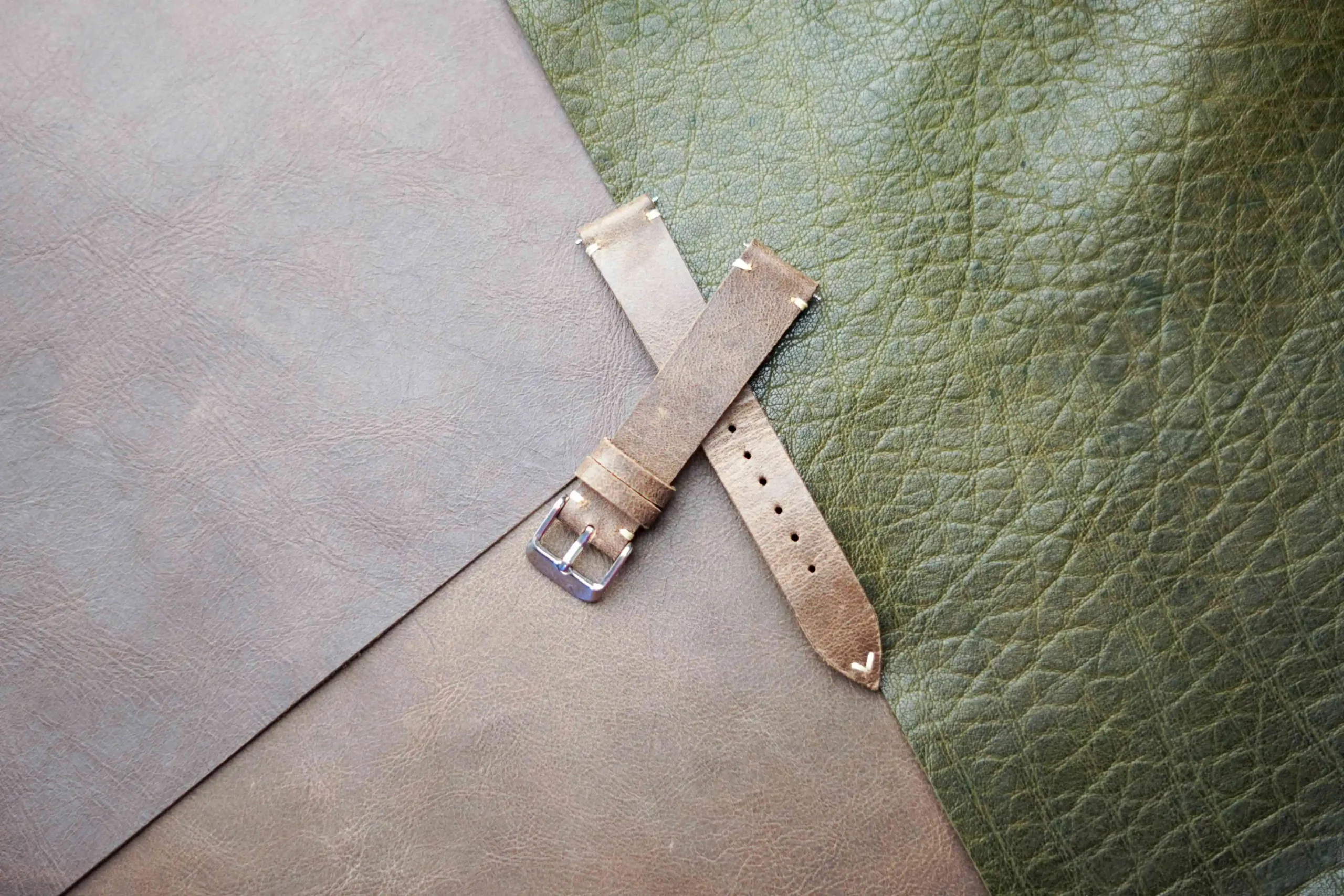
There's something special about a leather watch strap that's been worn for a long time. The colour runs deeper. The surface smooths in places. Creases start following the shape of your wrist. High-friction spots pick up a subtle sheen, and the leather often feels softer and more comfortable than it did the day it arrived.
Slowly, almost without noticing, the strap stops looking like the one that left the workshop. This transformation has a name: patina. It's sometimes mistaken for simple ageing or wear — but it isn't quite the same thing. Patina is one of the things that makes natural leather genuinely interesting: a visual and tactile record of time, use, and environment.
We build our straps from full-grain leather partly because of this exact quality — the material's ability to develop character over time. A new strap is only the beginning. How you wear it becomes part of its story.
What Is Patina, Exactly?
Patina is the gradual shift in a material's look and feel through age and use. With leather, that can mean deeper or more complex colour, increased surface sheen, softening, new creases, texture changes, darkening where friction is highest, and subtle variation from oils and handling.
There's no single "correct" appearance for it. A tan leather might darken dramatically. A natural leather might develop a rich amber tone. A darker leather might show subtle shifts in sheen rather than an obvious colour change. A heavily finished leather might barely change at all. Patina describes a process of transformation — not one specific look.
What Actually Causes It?
Leather is a natural material with a complex fibre structure, and its surface responds continuously to its environment. A handful of factors drive that change, and they rarely act alone:
Light & Friction
Sun exposure and constant contact with skin and clothing both reshape the surface over time.
Skin Oils & Sweat
What your skin naturally produces becomes part of the leather's ongoing story.
Handling & Flexing
Every time you put the watch on or take it off, the leather bends and moves a little more.
Environment
Climate and humidity shape how quickly and visibly a strap ages.
Finish & Tanning
How the leather was treated before it ever reached us sets the baseline for how it will change.
How It's Worn
Daily wear vs. occasional wear produces genuinely different results on the same leather.
That's exactly why two straps cut from the same hide can look completely different after a year in the wild.
Full-Grain Leather and Patina
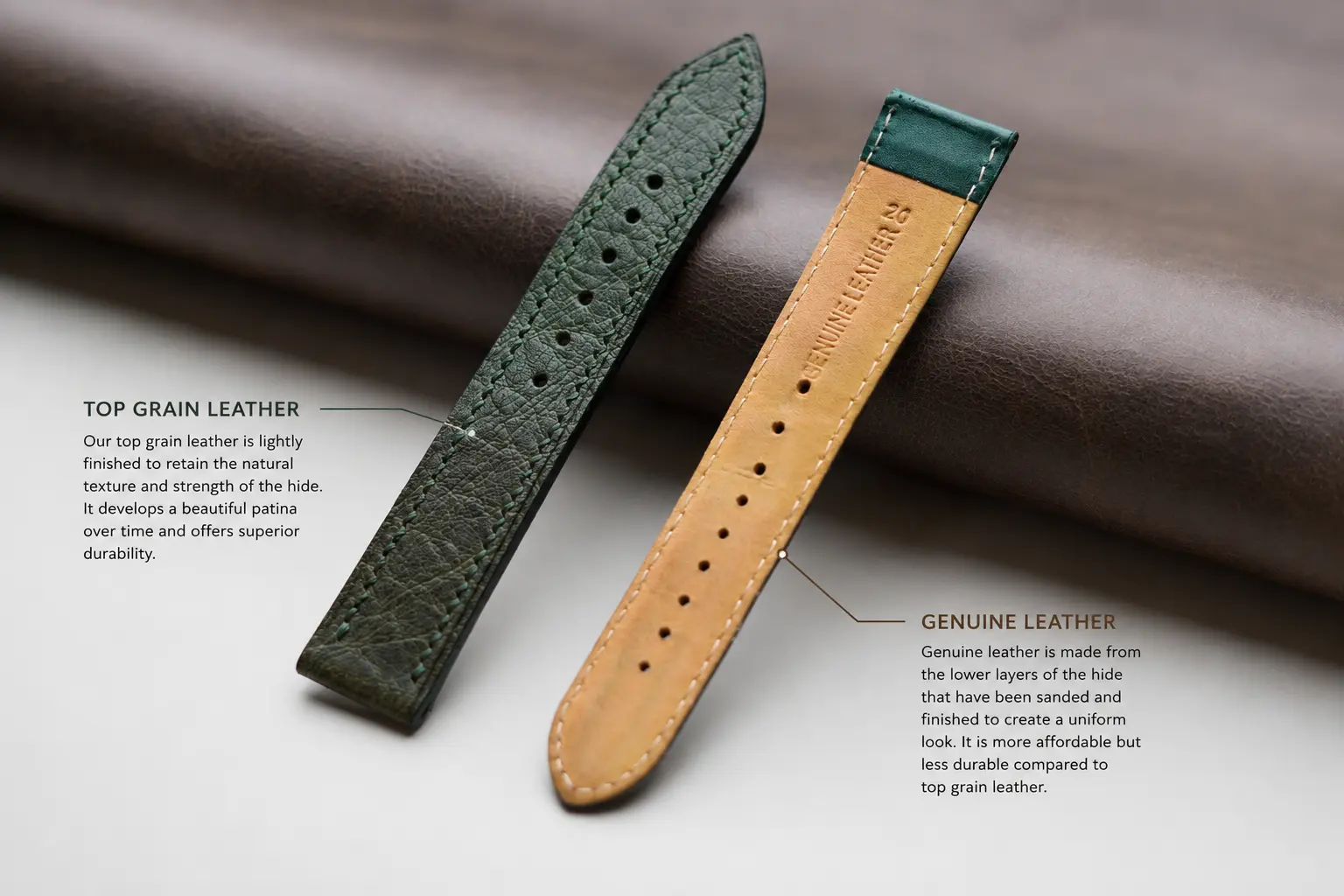
This is where full-grain leather gets particularly interesting. Because it retains the hide's natural grain surface rather than having it extensively corrected away, the material's original character stays part of the finished strap — and that surface can respond visibly to friction, oils, handling, light, bending, and time.
One important caveat: not every full-grain leather develops dramatic patina. How much it changes depends heavily on its finishing. A full-grain leather with a strong protective finish may stay fairly consistent; another with a more natural surface may transform considerably. "Full-grain" tells you something meaningful — just not the whole story.
Patina Isn't the Same as Damage
This distinction matters. Leather changes through use in three different ways — some desirable, some just normal wear, and some genuinely worth attention:
| Healthy Patina | Normal Wear | Needs Attention |
|---|---|---|
| Gradual colour change | Small scratches | Deep cracking or splitting |
| Subtle darkening | Minor edge rubbing | Torn leather |
| Increased sheen | Light surface marks | Loose or failing stitching |
| Natural creasing | Buckle-hole wear | Weakened spring-bar area |
| Gradual softening | — | Severely deteriorated lining |
A strap can be beautifully patinated and still completely sound. It can also look fairly new while hiding a real structural issue somewhere important. Always judge the whole strap, not just the surface.
Light, Friction, and Your Own Wrist
Light quietly reshapes leather over time — depending on the dyes and finish, exposure can deepen, fade, or shift its tone, which is part of why a strap kept in a drawer can end up looking different from an identical one worn daily. That said, patina isn't licence to leave a strap baking on a windowsill; wear it, don't roast it.
Friction plays its own role. A strap bends around your wrist constantly, rubs against clothing, and passes its buckle through the same holes again and again. Over time, high-contact areas smooth out and edges pick up a gentle polish — the surface is quite literally being shaped by everyday life.
And then there's you. Your wrist has its own temperature, perspiration, skin oils, and habits, and all of it feeds into how your particular strap ages. Someone wearing a watch twelve hours a day will get a different result than someone wearing it two hours on weekends; a humid climate produces a different pattern than a dry one; someone rotating five straps will see something different than someone who never takes theirs off. There's no universal patina — only the one created by a specific piece of leather, lived with by a specific person.
Why Tanning and Finishing Change the Story
Patina isn't just a full-grain question — the tanning process itself shapes how leather behaves. Vegetable-tanned leather, for instance, is well known for developing pronounced colour shifts over time, while other tanning systems tend toward a more visually stable result. Neither is objectively better; they're simply different kinds of leather with different personalities.
Finishing adds another layer entirely. Oils, waxes, pigments, dyes, protective coatings, embossed textures — all of it affects how a leather responds to light, friction, and moisture. A minimally finished leather can show change quickly; a heavily finished one might hold a consistent look for years. Some people love a strap that transforms dramatically; others prefer one that stays close to its original character. Neither preference is wrong.
Surface texture matters too. On smooth leather, changes tend to be easy to spot — a polished patch, a darker region. On textured leather, the grain distributes those changes differently, sometimes making subtle colour shifts less obvious while creating its own interesting highlights and shadows.
How Different Colours Age
Tan & Natural
Often the easiest to watch evolve — expect deeper colour, warmer tones, darker edges, and a gradient that maps out exactly where the strap gets handled most.
Black
Subtler by nature. Since it starts dark, the change shows up more in sheen, softened creases, and surface texture than in obvious colour shift.
Brown
Often the most expressive — darker edges, richer highlights, and real contrast between high- and low-contact zones as the leather gains visual depth.
Don't Try to Rush It
You'll find plenty of advice online about artificially speeding up patina — oils, alcohol, water, heat, abrasive materials. We wouldn't recommend any of it. These methods produce unpredictable results, and a visual change isn't automatically a beautiful one; more often, it's just a damaged finish wearing a different colour.
The same goes for deliberately scratching leather to make it look "aged." Genuine wear has context — a crease forms exactly where the strap bends, a polished patch forms exactly where friction happens, a darker section forms exactly where the leather gets handled. Artificial marks don't follow that logic; they're just marks. Patina tells a story. Random damage doesn't.
Conditioning falls in a similar category — it can darken leather or add sheen instantly, but that's a product effect, not the gradual result of time and wear. We'd rather you go easy on leather-care products than try to manufacture years of character in an afternoon.
If Your Strap Isn't Changing Much
That's not necessarily a problem. A heavily finished leather is often designed to stay visually consistent, and the amount of pigment, coating, wax, and surface treatment all shape how visible patina becomes. If your strap isn't transforming dramatically, that may simply be the character of that particular leather — not a flaw.
Along the same lines: patina isn't a reliable stand-alone measure of quality. A leather that changes a lot isn't automatically better than one that stays consistent, and vice versa. Real quality comes from hide selection, grain, fibre structure, tanning, finishing, construction, and durability working together — patina is one interesting characteristic among several, not the whole definition.
Why Straps Age Differently Than Bags or Wallets
A watch strap has a genuinely unique life. A handbag gets occasional handling; a wallet spends most of its time tucked in a pocket. A strap sits directly against your skin for hours at a stretch, absorbing heat, moisture, friction, movement, and light all at once. That combination is exactly why watch straps develop such personal character in relatively little time compared to other leather goods.
Look closely at a well-worn one and you'll often see patterns that say something about how you actually wear your watch — more wear near the buckle, colour variation on the underside, a smoother wrist-contact zone, stretching on your most-used hole, a crease pattern that hints at how snugly you wear it. The strap ends up quietly telling you something about its owner.
How to Encourage Healthy Patina
No special routine required — just a few sensible habits:
- Wear it regularly — character comes from use, not from sitting in a drawer.
- Rotate when you can — giving straps rest helps manage moisture naturally.
- Keep it away from prolonged water — a splash is fine, soaking isn't.
- Let it dry naturally — no artificial heat, ever.
- Keep it reasonably clean — a soft dry cloth handles most of it.
- Don't over-treat it — too many products can change leather unnecessarily.
- Accept the small marks — not everything needs correcting.
- Give it time — genuine patina can't be rushed without risking damage.
The Beauty of Imperfection
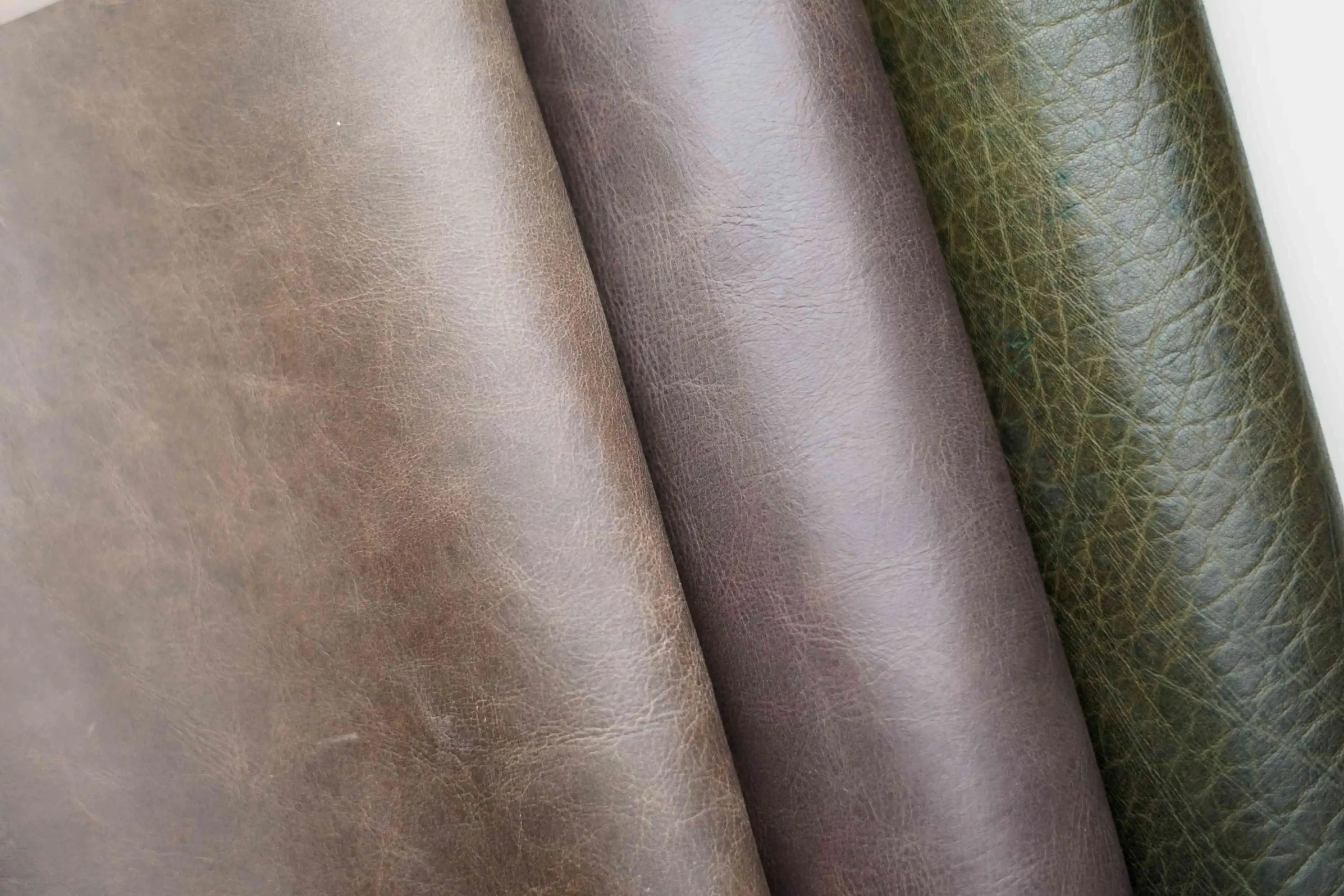
Modern manufacturing tends to chase uniformity — every unit identical, every surface consistent. Natural leather takes the opposite approach. The hide already has its own history before it ever reaches a workshop; then the maker shapes it, and the owner wears it, and the material keeps changing well after that. Two straps can start out identical and end up completely different — and that variation isn't a manufacturing flaw. It's simply what the material does.
That's exactly why we don't try to make every Nakshara strap look identical to the next. Precision and character aren't in conflict here — the construction stays exact (deliberate stitching, carefully finished edges, accurate dimensions, properly fitted hardware), while the leather itself is left free to be natural. A subtle variation in grain doesn't make one strap worse than another. It just makes them individual.
A New Strap Is Only the Beginning
When a new strap arrives, you're seeing the maker's work — the leather selected, cut, layered, stitched, edge-finished, and fitted with hardware. But its final character hasn't been written yet. That happens through wear: a little friction here, a little bending there, some light, some handling, some time. Eventually it becomes something that could never be reproduced exactly the same way twice in a workshop. It becomes yours.
Frequently Asked Questions
The Nakshara Perspective
We don't think a leather strap should be judged only by how it looks the day it arrives. A new strap is beautiful because of its craftsmanship. An old one can be beautiful because of its history. The best leather bridges both — starting refined, and gradually becoming personal.
We select the material carefully, build each strap by hand, and finish it knowing that time will eventually add something no maker ever could. Character. And that part comes from you.
Next time you notice a crease, don't read it as a flaw first. Look at where it formed. Notice how the surface has shifted, where it's grown smoother, how the colour catches the light differently now. Those are all signs of a strap that's actually been lived with — that's travelled with you, spent real time on your wrist, and slowly become something that belongs to no one else.
Crafted by hand. Made to last.
If you're looking for a strap that will develop its own character over time, every Nakshara strap is built from full-grain leather — made to age well with you.